

Advancing knowledge and cooperation for a healthy ocean and prosperous society


Background
Marine and coastal ecosystems, including coral reefs, seagrass meadows, mangroves, and coastal wetlands, harbor exceptionally high levels of species richness and endemism, providing significant resources and services for both wildlife and people. However, marine biodiversity and ecosystem health are increasingly threatened by intensifying human pressures and climate change. To design and implement effective conservation and management measures and to ensure their long-term effectiveness, our ability to monitor marine biodiversity and measure its change over a range of spatial and temporal scales is essential. Yet conventional approaches to marine biodiversity monitoring are labor-intensive, and difficult to scale across the extensive and often remote coastline of many countries.
Environmental DNA (eDNA) has emerged as an innovative approach for detecting species from genetic material shed into the environment, providing a cost-effective and scalable complement to conventional monitoring methods. Despite some limitations of eDNA methods, such as gaps in regional barcode libraries, eDNA-based biodiversity monitoring is developing rapidly and progressively being applied to support evidence-based marine ecosystem management and conservation decision-making.
In response to the increasing needs of Member States in the region, the IOC Sub-Commission for the Western Pacific (WESTPAC) convened its first ever eDNA workshop in the region, 27-29 November 2023, which stimulated strong interest and initiated pilot applications in several countries in the region.
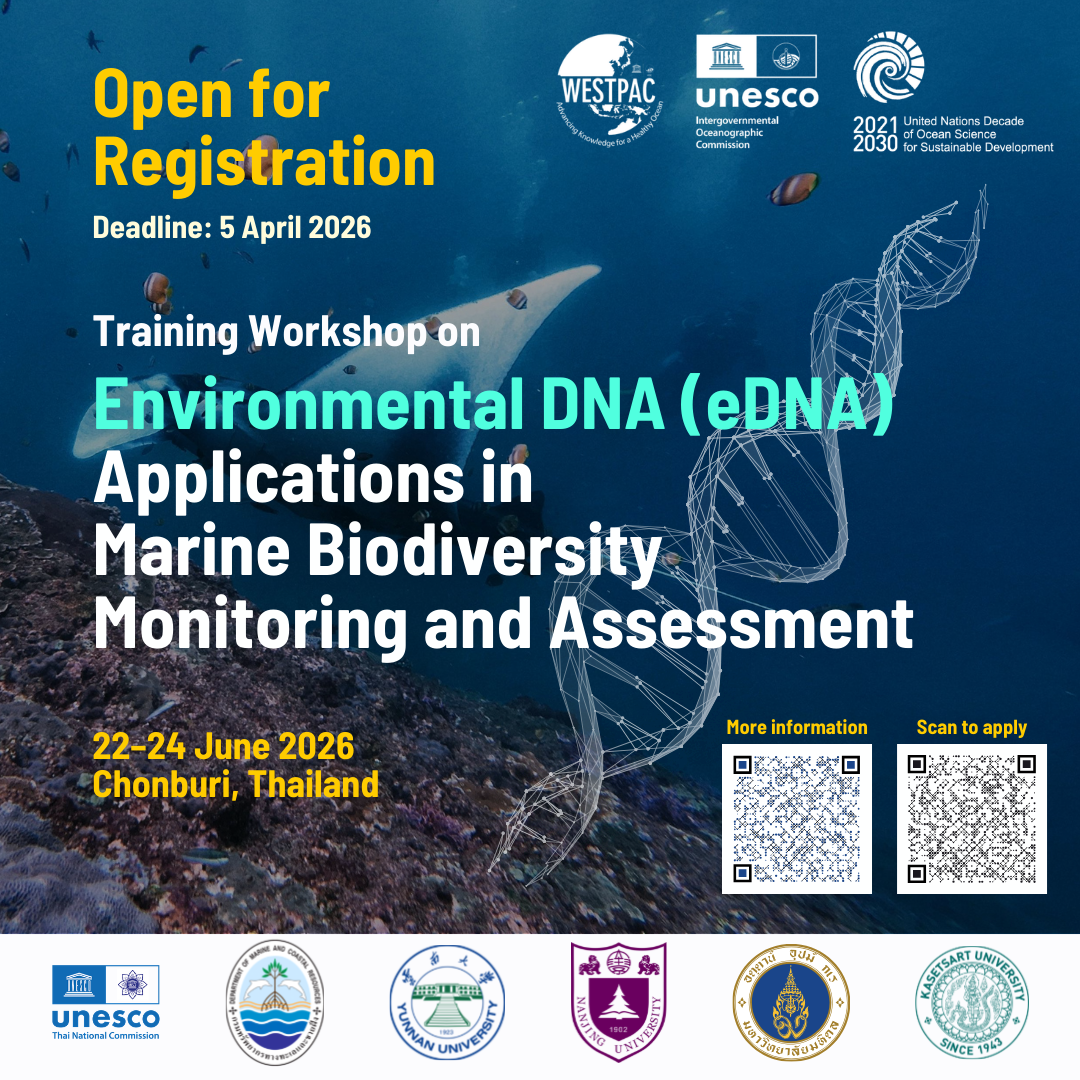
Building on its positive outcomes, and with the generous support of the Thai National Commission for UNESCO and Ministry of Education (Thailand), the IOC Sub-Commission for the Western Pacific (WESTPAC), in partnership with the Department of Marine and Coastal Resources (Thailand), Mahidol University (Thailand), Kasetsart University (Thailand), Yunnan University (China), and Nanjing University (China) will organize the second eDNA training workshop in Chonburi Province, Thailand, from 22 to 24 June 2026, to further enhance technical capacity and the application of environmental DNA (eDNA) for marine biodiversity monitoring and assessment.
Objectives
The workshop aims to:
Contents of the training workshop
This technical training workshop will consist of keynotes, theoretical lectures, professional field-based sampling exercises, practical laboratory demonstrations, and plenary discussions, covering:
Expected outputs
Venue
The training workshop will take place in Sri Racha, Chonburi Province, Thailand.
The Department of Marine and Coastal Resources (DMCR) will provide the necessary meeting and lab facilities for the training workshop, including a lecture room, labs equipped for the primary preparation and preservation of samples prior to further processing.
Tentative programme
The three-day workshop will include, but will not be limited to, the following sessions, with the detailed programme to be finalized in due course.
Session 1:Setting the context and workshop objectives
Session 2:Introduction to eDNA and its applications in marine biodiversity monitoring and analysis, including opportunities and limitations
Session 3:eDNA sampling design, field collection, and sample processing
Session 4:eDNA laboratory workflow and contamination control: from sample to amplified DNA ready for sequencing
Session 5:eDNA data analysis and interpretation: from sequences to species
Session 6:eDNA reference databases for marine organisms
Session 7:National status, experience, and capacity needs
Session 8:Hands-on demonstration, including field sampling, filtration and preservation, contamination control, laboratory preparation, DNA extraction and amplification
Session 9:Brainstorming session: the way forward
Session 10:Wrap-up and closing
Qualifications of participants
The training workshop is intended for government agencies and researcher institutions in WESTPAC Member States that are responsible for marine biodiversity monitoring and conservation, including those for MPA management.
Participants should:
Application
Interested applicants are required to complete the Online Registration/Application Form as early as possible, preferably by 5 April 2026.
As funding for international travel is limited, participants are encouraged to attend the workshops on a self-funded or partially self-funded basis. A limited amount of funding is available to support selected participants with priority given to those from developing countries in the region.
Applicants requesting travel support are also required to submit (i) a CV and (ii) a nomination letter from his/her institution. These documents should be sent by email to iocwestpac@unesco.org with the subject line: “CV and Nomination Letter – Training Workshop on Marine eDNA Applications”, by 5 April 2026.
Selection will be based primarily on the following criteria:
Updated information about the training workshop will be made available in due course on the related WESTPAC webpage.
Contact points
Department of Marine and Coastal Resources, Thailand
Ms Vararin Vongpanich
Email: khunvara@yahoo,com
Praderm Unthayanmanee
Email: auppree@hotmail.com
IOC Sub-Commission for the Western Pacific (WESTPAC) &
UN Ocean Decade Coordination Office for the Western Pacific
Intergovernmental Oceanographic Commission of UNESCO
Ms Nachapa Saransuth
Email: iocwestpac@unesco.org
Contact points
Ms Nachapa Saransuth
Email: iocwestpac@unesco.org
IOC Sub-Commission for the Western Pacific (WESTPAC) &
UN Ocean Decade Coordination Office for the Western Pacific
Intergovernmental Oceanographic Commission of UNESCO
Ms Vararin Vongpanich & Praderm Unthayanmanee
Email: khunvara@yahoo,com; auppree@hotmail.com
Department of Marine and Coastal Resources, Thailand
Important Links
| 1. | Concept note (pdf) |