
Loading Events

Busan, Republic of Korea, 13–17 July 2026

Introduction

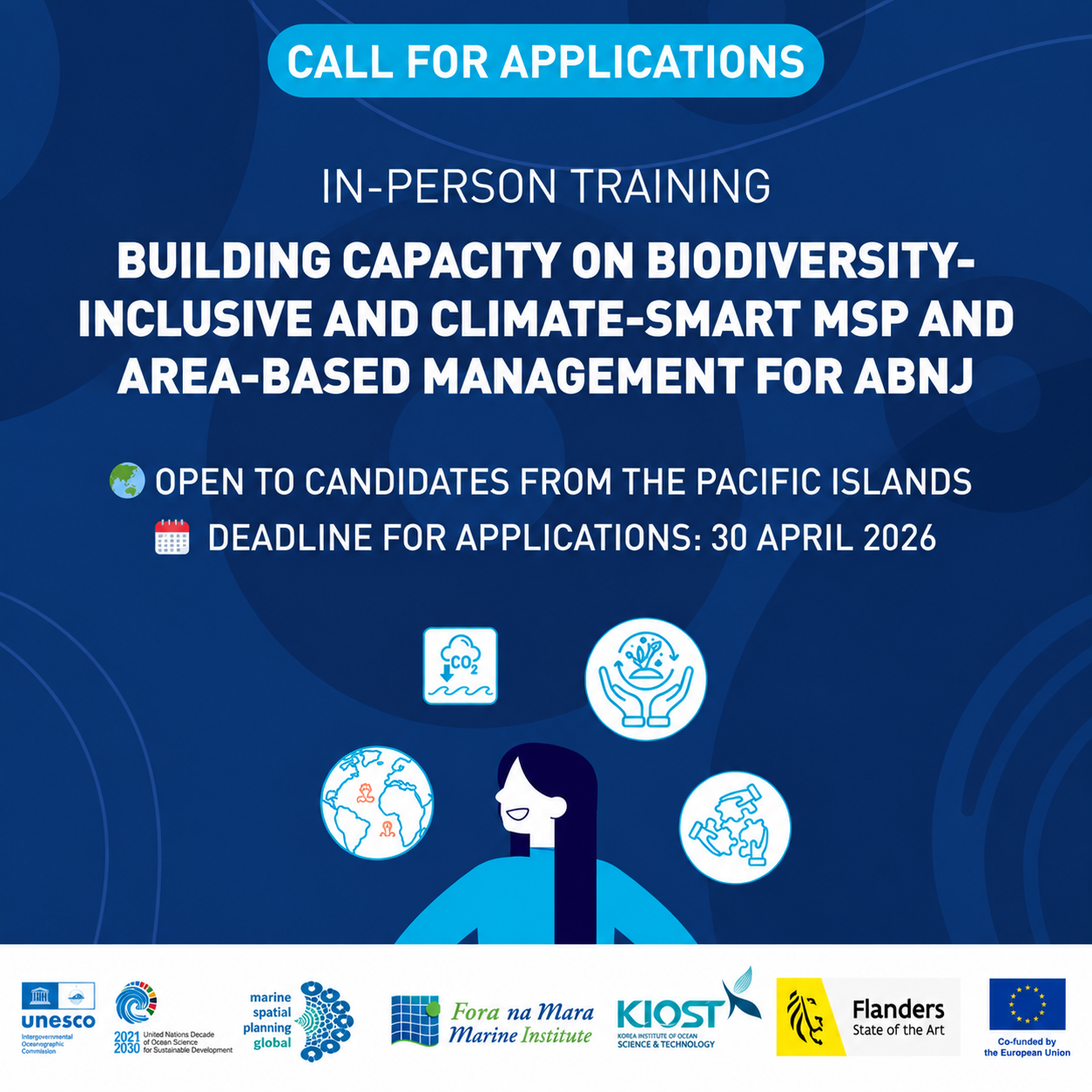
This in-person training is a joint initiative aiming to enhance national and regional capacity for marine spatial planning (MSP) with tools applied to areas within and beyond national jurisdiction, including ecosystem-based and climate-resilient approaches, and area-based management methodologies and processes.

This training course is jointly organized by the IOC (in support of the MSPglobalOcean Decade Capacity Development FacilityOceanTeacher Global Academy, and IOC Sub-Commission for the Western Pacific (WESTPAC)) in collaboration with the Korea Institute of Ocean Science and Technology (KIOST)

The training includes two parts:

Part 1:  Regional training on Biodiversity Inclusive and Climate Smart Marine Spatial Planning for Asia and Pacific, 13 to 14 July 2026

A 2-day course aiming to strengthen the capacity of MSP practitioners and decision-makers to integrate biodiversity conservation, climate adaptation and mitigation, and inclusive governance into planning processes. Building on the MSPglobal International Guide and its complementary volumes on Biodiversity-Inclusive and Climate-Smart MSP , the course combines conceptual alignment with hands-on application. Participants will develop a shared understanding of ecosystem-based and climate-resilient planning principles, explore the implications of biodiversity loss and climate change for marine management, and examine policy alignment and inclusive governance approaches. Through interactive exercises and a simulated MSP process, they will learn how to apply these principles across all phases of the MSP cycle from scoping and assessment to plan development, implementation, monitoring, and adaptive management.

Part 2: Applying Marine Spatial Planning Tools to Area-Based Management in Areas Beyond National Jurisdiction (ABNJ) for Asia and Pacific, 15 to 17 July 2026

This 3-day training equips practitioners working in MSP or MPA management, ocean governance, conservation, management, and related fields with the frameworks and practical knowledge needed to design Area-Based Management Tool (ABMT) proposals in Areas Beyond National Jurisdiction (ABNJ) under the BBNJ Agreement. Building on the MSPglobal International Guide on Marine Spatial Planning, the course bridges established MSP methodologies with the scientific and technical requirements of BBNJ governance and operationalization, exploring how biodiversity, climate, and equity — including the integration of traditional knowledge of Indigenous Peoples and Local Communities (IPLCs) — apply in ABNJ contexts.

*Note that self-sponsored participants may choose or be selected to participate in only one or both parts of the training. Participants who receive sponsorship from the organization must attend both parts. 

Workshop objectives

Part 1 of the training aims to:

  • Strengthen participants’ understanding of biodiversity-inclusive and climate-smart principles across the different phases of the marine spatial planning (MSP) process;
  • Support participants in identifying entry points for integrating biodiversity, climate, and equity considerations throughout the MSP cycle;
  • Enhance capacities to design and facilitate stakeholder engagement processes that promote inclusive and equitable marine governance;
  • Improve participants’ ability to communicate MSP strategies effectively to diverse audiences and stakeholders;
  • Encourage engagement in regional and global communities of practice on biodiversity-inclusive and climate-smart MSP.

Part 2 of the training aims to:

  • Provide an understanding of the scientific and technical requirements for area-based management tool (ABMT) proposals under the BBNJ Agreement, including relevant methodologies;
  • Clarify key components of biodiversity-inclusive and climate-smart spatial planning in the context of ABNJ governance;
  • Strengthen knowledge on the use of MSP-based analysis to support ABMT proposals, including the integration of global spatial datasets on biodiversity, human activities, and climate;
  • Raise awareness of the implications of data gaps for spatial decision-making and ABMT design and implementation;
  • Support participants in assessing how MSP spatial analysis approaches can be applied in their own national or regional contexts, including identifying relevant data sources, governance actors, and potential constraints.

Workshop participants

This training is designed for practitioners working in marine spatial planning (MSP), ocean governance, or related fields — particularly those involved in MSP processes or BBNJ implementation at national or regional levels, including the design and application of area-based management tools (ABMTs) in ABNJ.

List of eligible countries for the open call for participation: Cook Islands, Fiji, Kiribati, Maldives, Marshall Islands, Micronesia (Federated States of), Nauru, Niue, Palau, Papua New Guinea, Samoa, Solomon Islands, Timor-Leste, Torkelau, Tonga, Tuvalu, and Vanuatu.  

*Note remaining part of the available places will be dedicated to direct contact invitations issued by WESTPAC to its Member States.

Assessment & certificate

This training will include pre-and-post self-assessments, and a final assignment report.  

*Note that the preparation online courses suggested in the pre-requisites have a different assessment rationale, and certificate of completion. 

To receive a Certificate of Completion, for each part of the training course, participants shall: 

  • Fully attend to the in-person sessions 

  • Engage and complete every proposed training activity 

  • Successfully complete the report assignment 

 
1.Agenda